編輯:關於Android編程
文件存儲是 Android 中最基本的一種數據存儲方式,它不對存儲的內容進行任何的格式化處理,所有數據都是原封不動的保存到文件當中的。
概述
文件存取的核心就是輸入流和輸出流。
Android文件的操作模式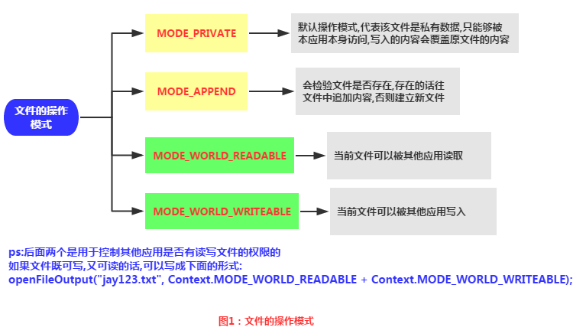
文件的相關操作方法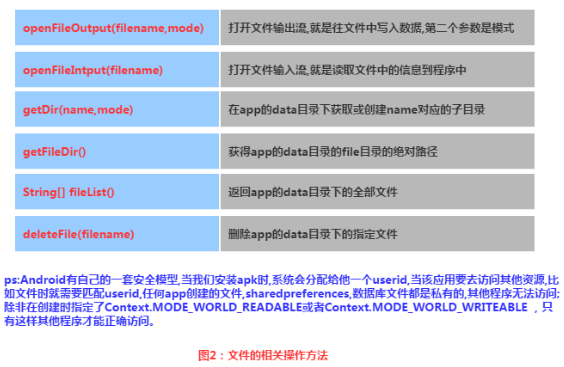
文件讀寫的實現
openFileOutput和openFileInput方法
 /**
   * openFIleOutput ,openFileInput
   * 這兩種方法同sp一樣只能講文件保存到手機內存固定的路徑中,
   * 默認為 /data/data/<packageName>/files
   */
  private void save2File() {
    try {
      //向文件寫入內容
      FileOutputStream os = openFileOutput("file.txt", Context.MODE_PRIVATE);
      String text = "寫數據到文件";
      os.write(text.getBytes("utf-8"));

      //關閉流
      os.close();
    } catch (FileNotFoundException e) {
      e.printStackTrace();
    } catch (UnsupportedEncodingException e) {
      e.printStackTrace();
    } catch (IOException e) {
      e.printStackTrace();
    }
  }

  /**
   *
   */
  private void readFile() {

    try {
      FileInputStream ins = openFileInput("file.txt");
      byte[] buffer = new byte[100];
      int byteCount = ins.read(buffer);
      String text = new String(buffer,0,byteCount,"utf-8");
      Toast.makeText(this,text,Toast.LENGTH_SHORT).show();

      ins.close();

    } catch (FileNotFoundException e) {
      e.printStackTrace();
    } catch (IOException e) {
      e.printStackTrace();
    }
  }
文件存儲位置
/data/data/<package-name>/files目錄下
openFileOutput和openFileInput方法可以獲得操作文件的OutputStream以及InputStream對象,而且可以通過流對象處理任何文件的數據,但是這兩個方法同SharedPreferences一樣,只能在手機內存卡的指定目錄建立文件,因此在使用上仍然有一定的局限性。
讀取SD卡上的文件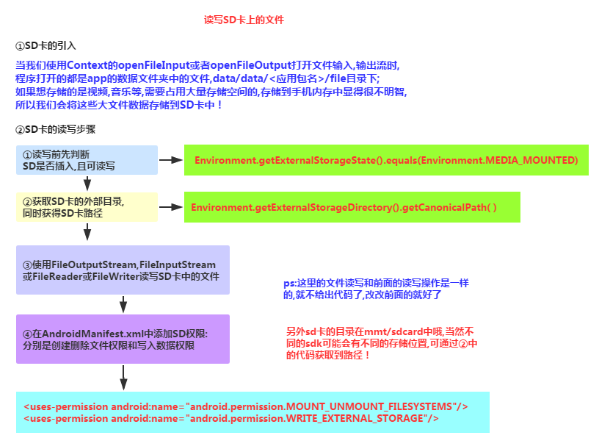
main_activity.xml:
<LinearLayout xmlns:android="http://schemas.android.com/apk/res/android"
  xmlns:tools="http://schemas.android.com/tools"
  android:id="@+id/LinearLayout1"
  android:layout_width="match_parent"
  android:layout_height="match_parent"
  android:orientation="vertical"
  tools:context="com.jay.example.filedemo2.MainActivity">

  <TextView
    android:layout_width="wrap_content"
    android:layout_height="wrap_content"
    android:text="清輸入文件名" />

  <EditText
    android:id="@+id/edittitle"
    android:layout_width="match_parent"
    android:layout_height="wrap_content"
    android:hint="文件名" />


  <TextView
    android:layout_width="wrap_content"
    android:layout_height="wrap_content"
    android:text="清輸入文件內容" />

  <EditText
    android:id="@+id/editdetail"
    android:layout_width="match_parent"
    android:layout_height="wrap_content"
    android:hint="文件內容" />

  <Button
    android:id="@+id/btnsave"
    android:layout_width="wrap_content"
    android:layout_height="wrap_content"
    android:text="保存到SD卡" />

  <Button
    android:id="@+id/btnclean"
    android:layout_width="wrap_content"
    android:layout_height="wrap_content"
    android:text="清空" />

  <Button
    android:id="@+id/btnread"
    android:layout_width="wrap_content"
    android:layout_height="wrap_content"
    android:text="讀取sd卡中的文件" />

</LinearLayout>
接著我們來寫一個SD操作類: SDFileHelper.Java
public class SDFileHelper {

  private Context context;

  public SDFileHelper() {
  }

  public SDFileHelper(Context context) {
    super();
    this.context = context;
  }

  //往SD卡寫入文件的方法
  public void savaFileToSD(String filename, String filecontent) throws Exception {
    //如果手機已插入sd卡,且app具有讀寫sd卡的權限
    if (Environment.getExternalStorageState().equals(Environment.MEDIA_MOUNTED)) {
      filename = Environment.getExternalStorageDirectory().getCanonicalPath() + "/" + filename;
      //這裡就不要用openFileOutput了,那個是往手機內存中寫數據的
      FileOutputStream output = new FileOutputStream(filename);
      output.write(filecontent.getBytes());
      //將String字符串以字節流的形式寫入到輸出流中
      output.close();
      //關閉輸出流
    } else Toast.makeText(context, "SD卡不存在或者不可讀寫", Toast.LENGTH_SHORT).show();
  }

  //讀取SD卡中文件的方法
  //定義讀取文件的方法:
  public String readFromSD(String filename) throws IOException {
    StringBuilder sb = new StringBuilder("");
    if (Environment.getExternalStorageState().equals(Environment.MEDIA_MOUNTED)) {
      filename = Environment.getExternalStorageDirectory().getCanonicalPath() + "/" + filename;
      //打開文件輸入流
      FileInputStream input = new FileInputStream(filename);
      byte[] temp = new byte[1024];

      int len = 0;
      //讀取文件內容:
      while ((len = input.read(temp)) > 0) {
        sb.append(new String(temp, 0, len));
      }
      //關閉輸入流
      input.close();
    }
    return sb.toString();
  }


}
接著MainActivity.java實現相關邏輯:
public class MainActivity extends AppCompatActivity implements View.OnClickListener{

  private EditText editname;
  private EditText editdetail;
  private Button btnsave;
  private Button btnclean;
  private Button btnread;
  private Context mContext;

  @Override
  protected void onCreate(Bundle savedInstanceState) {
    super.onCreate(savedInstanceState);
    setContentView(R.layout.activity_main);
    mContext = getApplicationContext();
    bindViews();
  }

  private void bindViews() {
    editname = (EditText) findViewById(R.id.edittitle);
    editdetail = (EditText) findViewById(R.id.editdetail);
    btnsave = (Button) findViewById(R.id.btnsave);
    btnclean = (Button) findViewById(R.id.btnclean);
    btnread = (Button) findViewById(R.id.btnread);

    btnsave.setOnClickListener(this);
    btnclean.setOnClickListener(this);
    btnread.setOnClickListener(this);
  }

  @Override
  public void onClick(View v) {
    switch (v.getId()){
      case R.id.btnclean:
        editdetail.setText("");
        editname.setText("");
        break;
      case R.id.btnsave:
        String filename = editname.getText().toString();
        String filedetail = editdetail.getText().toString();
        SDFileHelper sdHelper = new SDFileHelper(mContext);
        try
        {
          sdHelper.savaFileToSD(filename, filedetail);
          Toast.makeText(getApplicationContext(), "數據寫入成功", Toast.LENGTH_SHORT).show();
        }
        catch(Exception e){
          e.printStackTrace();
          Toast.makeText(getApplicationContext(), "數據寫入失敗", Toast.LENGTH_SHORT).show();
        }
        break;
      case R.id.btnread:
        String detail = "";
        SDFileHelper sdHelper2 = new SDFileHelper(mContext);
        try
        {
          String filename2 = editname.getText().toString();
          detail = sdHelper2.readFromSD(filename2);
        }
        catch(IOException e){e.printStackTrace();}
        Toast.makeText(getApplicationContext(), detail, Toast.LENGTH_SHORT).show();
        break;
    }
  }
}
最後別忘記在AndroidManifest.xml寫上讀寫SD卡的權限哦!
<!-- 在SDCard中創建與刪除文件權限 -->
<uses-permission android:name="android.permission.MOUNT_UNMOUNT_FILESYSTEMS"/>
<!-- 往SDCard寫入數據權限 -->
<uses-permission android:name="android.permission.WRITE_EXTERNAL_STORAGE"/>
如何判斷虛擬和物理兩種SDK
在默認情況下,會將一部分存儲空間分給虛擬的SD卡使用(一部分用於安裝Android操作系統)
android.os.Enviroment.isExternalStorageRemovalbe()
返回true:SD卡是物理的,反之SD卡是虛擬的。
用於適配不同型號手機,反射獲取SD卡路徑和狀態
package com.turing.base.activity.dataStore.fileStore;

import android.content.Context;
import android.os.Environment;
import android.os.StatFs;
import android.os.storage.StorageManager;
import android.text.TextUtils;
import android.util.Log;

import java.io.File;
import java.lang.reflect.InvocationTargetException;
import java.lang.reflect.Method;
import java.util.concurrent.ConcurrentLinkedQueue;
import java.util.concurrent.ExecutorService;
import java.util.concurrent.Executors;

/**
 * 用於適配不同型號手機,反射獲取SD卡路徑和狀態
 *
 */
public class DevMountInfo {

  private final String TAG = DevMountInfo.class.getSimpleName();

  private static final int ERROR = -1;

  // class name
  private final static String CLASS_NAME = "android.os.storage.StorageVolume";

  //remained spare memory size
  private static final int REMAINED_SPARE_IN_MB = 100;

  // method name
  private final static String METHOD_GET_VOLUME_LIST = "getVolumeList";
  private final static String METHOD_GET_VOLUME_STATE = "getVolumeState";
  private final static String METHOD_IS_REMOVABLE = "isRemovable";
  private final static String METHOD_GET_PATH = "getPath";

  private final static String MOUNTED = "mounted";

  private static DevMountInfo INSTANCE;

  private String mSDCardPath = null;

  // internal file path
  private ConcurrentLinkedQueue<String> mInternalPathList = new ConcurrentLinkedQueue<String>();
  // external file path
  private ConcurrentLinkedQueue<String> mExternalPathList = new ConcurrentLinkedQueue<String>();

  private ExecutorService mExecutor = null;

  private DevMountInfo() {
    mExecutor = Executors.newSingleThreadExecutor();
  }

  public static DevMountInfo getInstance() {
    synchronized (DevMountInfo.class) {
      if (null == INSTANCE) {
        INSTANCE = new DevMountInfo();
      }
      return INSTANCE;
    }
  }

  @Override
  protected void finalize() throws Throwable {
    super.finalize();
    synchronized (DevMountInfo.class) {
      mInternalPathList.clear();
      mExternalPathList.clear();
      mExecutor.shutdown();
      INSTANCE = null;
    }
  }

  public void init(final Context context) {
    mExecutor.execute(new Runnable() {
      @Override
      public void run() {
        executeInit(context);
      }
    });
  }

  public boolean isSDCardFull() {
    return REMAINED_SPARE_IN_MB > (getSDCardAvailSpace() * 1024);
  }

  public boolean isSDCardAvaiable() {

    return !mExternalPathList.isEmpty() || !mInternalPathList.isEmpty();
  }

  public String getSDCardPath() {
    return mSDCardPath;
  }

  public long getSDCardTotalSpace() {
    long totalSpace = 0;
    if (!TextUtils.isEmpty(mSDCardPath)) {
      StatFs sf = new StatFs(mSDCardPath);
      long blockSize = sf.getBlockSize();
      long total = sf.getBlockCount();
      totalSpace = total * blockSize / 1024;
    }
    return totalSpace;
  }

  public long getSDCardAvailSpace() {
    long availSpace = 0;
    if (!TextUtils.isEmpty(mSDCardPath)) {
      StatFs sf = new StatFs(mSDCardPath);
      long blockSize = sf.getBlockSize();
      long availCount = sf.getAvailableBlocks();
      availSpace = availCount * blockSize / 1024;
    }
    return availSpace;
  }

  public String getInternalSDCardPath() {

    return mInternalPathList.peek();
  }

  public String getExternalSDCardPath() {

    return mExternalPathList.peek();
  }

  private void executeInit(Context context) {
    StorageManager mStorageManager = (StorageManager) context.getSystemService(Context.STORAGE_SERVICE);
    if (mStorageManager != null) {
      Class<?> mStorageVolume = null;
      Method mGetVolumeListMethod = null;
      Method mGetVolumeStateMethod = null;
      Method mGetPathMethod = null;
      Method mIsRemovableMethod = null;
      Object[] mStorageVolumeList = null;
      try {
        mStorageVolume = Class.forName(CLASS_NAME);
        mGetVolumeListMethod = mStorageManager.getClass().getMethod(METHOD_GET_VOLUME_LIST, new Class[0]);
        mGetVolumeStateMethod = mStorageManager.getClass().getMethod(METHOD_GET_VOLUME_STATE, new Class[]{String.class});
        mIsRemovableMethod = mStorageVolume.getMethod(METHOD_IS_REMOVABLE, new Class[0]);
        mGetPathMethod = mStorageVolume.getMethod(METHOD_GET_PATH, new Class[0]);

        mStorageVolumeList = (Object[]) mGetVolumeListMethod.invoke(mStorageManager, new Object[0]);

        boolean mIsRemovable = false;

        if (mStorageVolumeList != null && mStorageVolumeList.length > 0) {
          int mStorageVolumeCount = mStorageVolumeList.length;

          Log.i(TAG, "init() === > StorageVolume Count = " + mStorageVolumeCount);


          mInternalPathList.clear();
          mExternalPathList.clear();

          for (int i = 0; i < mStorageVolumeCount; ++i) {
            String mStoragePath = (String) mGetPathMethod.invoke(mStorageVolumeList[i], new Object[0]);
            mIsRemovable = ((Boolean) mIsRemovableMethod.invoke(mStorageVolumeList[i], new Object[0])).booleanValue();
            if (!TextUtils.isEmpty(mStoragePath)) {
              String state = (String) mGetVolumeStateMethod.invoke(mStorageManager, new Object[]{mStoragePath});
              if ((state != null) && (state.equals(MOUNTED))) {
                if (mIsRemovable) {
                  Log.i(TAG, "init() === > external storage path = (" + mStoragePath + ")");
                  mExternalPathList.add(mStoragePath);
                } else {
                  Log.i(TAG, "init() === > internal storage path = (" + mStoragePath + ")");
                  mInternalPathList.add(mStoragePath);
                }
              }
            }
          }
        }
      } catch (ClassNotFoundException e) {
        handleInvalid();
        Log.e(TAG, "init() === > Exception:ClassNotFoundException");
      } catch (NoSuchMethodException e) {
        handleInvalid();
        Log.e(TAG, "init() === > Exception:NoSuchMethodException");
      } catch (IllegalArgumentException e) {
        handleInvalid();
        Log.e(TAG, "init() === > Exception:IllegalArgumentException");
      } catch (IllegalAccessException e) {
        handleInvalid();
        Log.e(TAG, "init() === > Exception:IllegalAccessException");
      } catch (InvocationTargetException e) {
        handleInvalid();
        Log.e(TAG, "init() === > Exception:InvocationTargetException");
      }
    } else {
      handleInvalid();
      Log.e(TAG, "init() === > can't get storage manager");
    }
    initSDCardPath();
  }

  private void handleInvalid() {
    mInternalPathList.add(Environment.getExternalStorageDirectory().getPath());
  }

  private void initSDCardPath() {
    if (!mExternalPathList.isEmpty()) {
      mSDCardPath = mExternalPathList.peek();
    } else if (!mInternalPathList.isEmpty()) {
      mSDCardPath = mInternalPathList.peek();
    } else {
      mSDCardPath = Environment.getExternalStorageDirectory().getPath();
    }
    Log.i(TAG, "initSDCardPath() === > SDCARD PATH = (" + mSDCardPath + ")");
  }


  /**
   * SDCARD是否存
   */
  public static boolean externalMemoryAvailable() {
    return android.os.Environment.getExternalStorageState().equals(
        android.os.Environment.MEDIA_MOUNTED);
  }

  /**
   * 獲取手機內部剩余存儲空間
   *
   * @return
   */
  public static long getAvailableInternalMemorySize() {
    File path = Environment.getDataDirectory();
    StatFs stat = new StatFs(path.getPath());
    long blockSize = stat.getBlockSize();
    long availableBlocks = stat.getAvailableBlocks();
    return availableBlocks * blockSize;
  }

  /**
   * 獲取手機內部總的存儲空間
   *
   * @return
   */
  public static long getTotalInternalMemorySize() {
    File path = Environment.getDataDirectory();
    StatFs stat = new StatFs(path.getPath());
    long blockSize = stat.getBlockSize();
    long totalBlocks = stat.getBlockCount();
    return totalBlocks * blockSize;
  }

  /**
   * 獲取手機內置存儲剩余存儲空間
   *
   * @return
   */
  public static long getAvailableInternalSystemMemorySize() {
    File path = Environment.getRootDirectory();
    StatFs stat = new StatFs(path.getPath());
    long blockSize = stat.getBlockSize();
    long availableBlocks = stat.getAvailableBlocks();
    return availableBlocks * blockSize;
  }

  /**
   * 獲取手機內置存儲總的存儲空間
   *
   * @return
   */
  public static long getTotalInternalSystemMemorySize() {
    File path = Environment.getRootDirectory();
    StatFs stat = new StatFs(path.getPath());
    long blockSize = stat.getBlockSize();
    long totalBlocks = stat.getBlockCount();
    return totalBlocks * blockSize;
  }

  /**
   * 獲取SDCARD剩余存儲空間
   *
   * @return
   */
  public static long getAvailableExternalMemorySize() {
    if (externalMemoryAvailable()) {
      File path = Environment.getExternalStorageDirectory();
      StatFs stat = new StatFs(path.getPath());
      long blockSize = stat.getBlockSize();
      long availableBlocks = stat.getAvailableBlocks();
      return availableBlocks * blockSize;
    } else {
      return ERROR;
    }
  }

  /**
   * 獲取SDCARD總的存儲空間
   *
   * @return
   */
  public static long getTotalExternalMemorySize() {
    if (externalMemoryAvailable()) {
      File path = Environment.getExternalStorageDirectory();
      StatFs stat = new StatFs(path.getPath());
      long blockSize = stat.getBlockSize();
      long totalBlocks = stat.getBlockCount();
      return totalBlocks * blockSize;
    } else {
      return ERROR;
    }
  }

  public static long getAvailableMemorySize(String path) {
    if (null == path)
      return 0;
    StatFs stat = new StatFs(path);
    long blockSize = stat.getBlockSize();
    long availableBlocks = stat.getAvailableBlocks();
    return availableBlocks * blockSize;
  }


}
讀取raw和assets文件夾下的文件
相信大家對兩個文件夾並不陌生,如果我們不想自己的文件被編譯成二進制文件的話, 我們可以把文件放到這兩個目錄下,而兩者的區別如下:
讀取文件資源:
res/raw:
InputStream is =getResources().openRawResource(R.raw.filename);
assets:
AssetManager am = getAssets();
InputStream is = am.open("filename");
SAX引擎讀取XML文件
sax引擎讀取xml文件的原理:
sax技術在處理xml文件時並不一次性把xml文件裝入內存,而是一邊讀一般解析。
使用sax處理xml需要一個Handler對象,一般會使用org.xml.sax.helpers.DefaultHandler的子類作為Handler對象
因此,這就需要處理如下5個分析點,也可稱為分析事件:
Code
res\raw\product.xml
<?xml version="1.0" encoding="utf-8"?>
<products>
  <product>
    <id>10</id>
    <name>電腦</name>
    <price>2067.25</price>
  </product>
  <product>
    <id>20</id>
    <name>微波爐</name>
    <price>520</price>
  </product>
  <product>
    <id>30</id>
    <name>洗衣機</name>
    <price>2400</price>
  </product>

</products>
Product.java
public class Product
{
  private int id;
  private String name;
  private float price;
  public int getId()
  {
    return id;
  }
  public void setId(int id)
  {
    this.id = id;
  }
  public String getName()
  {
    return name;
  }
  public void setName(String name)
  {
    this.name = name;
  }
  public float getPrice()
  {
    return price;
  }
  public void setPrice(float price)
  {
    this.price = price;
  }


}
XML2Product.java(DefaultHandler子類)
DefaultHandler子類 ,核心類,負責處理分析點事件。
import org.xml.sax.Attributes;
import org.xml.sax.SAXException;
import org.xml.sax.helpers.DefaultHandler;

import java.util.ArrayList;
import java.util.List;

public class XML2Product extends DefaultHandler {
  private List<Product> products;
  private Product product;


  private StringBuffer buffer = new StringBuffer();

  public List<Product> getProducts() {
    return products;
  }

  @Override
  public void characters(char[] ch, int start, int length)
      throws SAXException {

    buffer.append(ch, start, length);
    super.characters(ch, start, length);
  }

  @Override
  public void startDocument() throws SAXException {
    // 開始分析xml文件,創建List對象用於保存分析完的Product對象
    products = new ArrayList<Product>();

  }

  @Override
  public void startElement(String uri, String localName, String qName,
               Attributes attributes) throws SAXException {

    if (localName.equals("product")) {
      // 如果分析的是<product>標簽,則創建一個Product對象
      product = new Product();
    }
    super.startElement(uri, localName, qName, attributes);
  }


  @Override
  public void endElement(String uri, String localName, String qName)
      throws SAXException {
    if (localName.equals("product")) {
      // 處理完 <product>標簽後 將product對象添加到products中
      products.add(product);
    } else if (localName.equals("id")) {
      // 設置id屬性的值
      product.setId(Integer.parseInt(buffer.toString().trim()));
      // 將標簽內容的緩存區清空
      buffer.setLength(0);
    } else if (localName.equals("name")) {
      product.setName(buffer.toString().trim());
      buffer.setLength(0);
    } else if (localName.equals("price")) {
      product.setPrice(Float.parseFloat(buffer.toString().trim()));
      buffer.setLength(0);
    }
    super.endElement(uri, localName, qName);
  }
}
Xml2JavaObjectAct
import android.app.AlertDialog;
import android.os.Bundle;
import android.support.v7.app.AppCompatActivity;
import android.util.Xml;
import android.view.View;

import com.turing.base.R;

import java.io.InputStream;
import java.util.List;

public class Xml2JavaObjectAct extends AppCompatActivity {

  @Override
  protected void onCreate(Bundle savedInstanceState) {
    super.onCreate(savedInstanceState);
    setContentView(R.layout.activity_xml2_java_object);
  }


  public void onClick_XMLToObject(View view) {
    try {
      // 打開資源文件
      InputStream is = getResources().openRawResource(R.raw.products);
      XML2Product xml2Product = new XML2Product();
      // 開始分析priducts.xml文件
      android.util.Xml.parse(is, Xml.Encoding.UTF_8, xml2Product);
      // 輸出轉換後的java對象
      List<Product> products = xml2Product.getProducts();
      String msg = "共" + products.size() + "個產品\n";
      for (Product product : products) {
        msg += "id:" + product.getId() + " 產品名:" + product.getName()
            + " 價格:" + product.getPrice() + "\n";
      }
      // 彈出對話框
      new AlertDialog.Builder(this).setTitle("產品信息").setMessage(msg)
          .setPositiveButton("關閉", null).show();
    } catch (Exception e) {

    }

  }
}
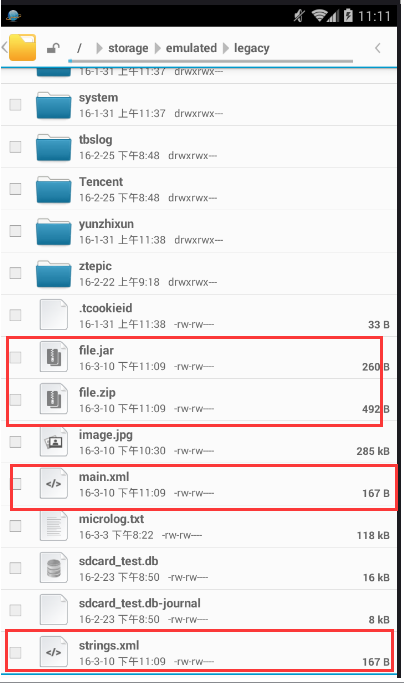
效果圖
Code
activity_jar_zip.xml
<?xml version="1.0" encoding="utf-8"?>
<LinearLayout xmlns:android="http://schemas.android.com/apk/res/android"
  android:layout_width="fill_parent"
  android:layout_height="fill_parent"
  android:orientation="vertical" >

  <Button
    android:layout_width="fill_parent"
    android:layout_height="wrap_content"
    android:onClick="onClick_Jar_Compress"
    android:text="用jar格式壓縮文件" />

  <Button
    android:layout_width="fill_parent"
    android:layout_height="wrap_content"
    android:onClick="onClick_Jar_Uncompress"
    android:text="解壓jar格式文件" />

  <Button
    android:layout_width="fill_parent"
    android:layout_height="wrap_content"
    android:onClick="onClick_Zip_Compress"
    android:text="用zip格式壓縮文件" />

  <Button
    android:layout_width="fill_parent"
    android:layout_height="wrap_content"
    android:onClick="onClick_Zip_Uncompress"
    android:text="解壓zip格式文件" />

</LinearLayout>
JarZipAct
import android.os.Bundle;
import android.support.v7.app.AppCompatActivity;
import android.view.View;
import android.widget.Toast;

import com.turing.base.R;

import java.io.File;
import java.io.FileInputStream;
import java.io.FileOutputStream;
import java.io.InputStream;
import java.util.jar.JarEntry;
import java.util.jar.JarInputStream;
import java.util.jar.JarOutputStream;
import java.util.zip.ZipEntry;
import java.util.zip.ZipInputStream;
import java.util.zip.ZipOutputStream;

public class JarZipAct extends AppCompatActivity {

  @Override
  protected void onCreate(Bundle savedInstanceState) {
    super.onCreate(savedInstanceState);
    setContentView(R.layout.activity_jar_zip);
  }

  public void onClick_Jar_Compress(View view) {
    try {
      // 使用FileOutputStream對象指定一個要輸出的壓縮文件(file.jar)
      FileOutputStream fos = new FileOutputStream(
          android.os.Environment.getExternalStorageDirectory()
              + "/file.jar");
      // 第一步 創建JarOutputStream對象
      JarOutputStream jos = new JarOutputStream(fos);
      // 第二步 創建一個JarEntry對象,並指定待壓縮文件在壓縮包中的文件名
      JarEntry jarEntry = new JarEntry("strings.xml");
      jos.putNextEntry(jarEntry);

      InputStream is = getResources().getAssets().open("strings.xml");
      byte[] buffer = new byte[8192];
      int count = 0;
      // 第四步 寫入數據
      while ((count = is.read(buffer)) >= 0) {
        jos.write(buffer, 0, count);
      }
      // 第五步 關閉當前的JarEntry等對象
      is.close();
      jos.closeEntry();
      jos.close();
      Toast.makeText(this, "成功將strings.xml文件以jar格式壓縮.", Toast.LENGTH_LONG)
          .show();

    } catch (Exception e) {
      Toast.makeText(this, e.getMessage(), Toast.LENGTH_LONG).show();
    }
  }

  public void onClick_Jar_Uncompress(View view) {
    try {
      // 定義要解壓的文件
      String filename = android.os.Environment
          .getExternalStorageDirectory() + "/file.jar";
      if (!new File(filename).exists()) {
        Toast.makeText(this, "壓縮文件不存在.", Toast.LENGTH_LONG).show();
        return;
      }
      // 使用FileInputStream對象指定要解壓的對象
      FileInputStream fis = new FileInputStream(filename);
      // 1 創建JarInputStream對象來讀取壓縮文件(file.jar)
      JarInputStream jis = new JarInputStream(fis);
      // 2 調用getNextJarEntry方法打開壓縮包中的第一個文件 ,如果有多個,多次調用該方法
      JarEntry jarEntry = jis.getNextJarEntry();
      // 3 輸出已解壓的文件
      FileOutputStream fos = new FileOutputStream(
          android.os.Environment.getExternalStorageDirectory()
              + "/" + jarEntry.getName());

      byte[] buffer = new byte[8192];
      int count = 0;
      // 4 輸出已解壓的字節流
      while ((count = jis.read(buffer)) >= 0) {
        fos.write(buffer, 0, count);
      }
      // 5 關閉
      jis.closeEntry();
      jis.close();
      fos.close();

      Toast.makeText(this, "成功解壓jar格式的文件.", Toast.LENGTH_LONG).show();

    } catch (Exception e) {
      Toast.makeText(this, e.getMessage(), Toast.LENGTH_LONG).show();
    }
  }

  public void onClick_Zip_Compress(View view) {
    try {
      // 指定了2個待壓縮的w文件,都在assets目錄中
      String[] filenames = new String[]
          {"main.xml", "strings.xml"};
      FileOutputStream fos = new FileOutputStream(
          android.os.Environment.getExternalStorageDirectory()
              + "/file.zip");
      ZipOutputStream zos = new ZipOutputStream(fos);
      int i = 1;
      //枚舉filenames中的所有待壓縮文件
      while (i <= filenames.length) {
        // 從filenames數組中取出當前待壓縮的溫佳明,作為壓縮後的文件名,以保持要說前後文件名稱一致
        ZipEntry zipEntry = new ZipEntry(filenames[i - 1]);
        // 打開當前的ZipEntry對象
        zos.putNextEntry(zipEntry);


        InputStream is = getResources().getAssets().open(
            filenames[i - 1]);
        byte[] buffer = new byte[8192];
        int count = 0;
        // 寫入數據
        while ((count = is.read(buffer)) >= 0) {
          zos.write(buffer, 0, count);
        }
        zos.flush();
        // 關閉當前的ZipEntry對象
        zos.closeEntry();
        is.close();
        i++;

      }
      zos.finish();
      zos.close();
      Toast.makeText(this, "成功將main.xml、strings.xml文件以zip格式壓縮.",
          Toast.LENGTH_LONG).show();

    } catch (Exception e) {
      Toast.makeText(this, e.getMessage(), Toast.LENGTH_LONG).show();
    }

  }

  public void onClick_Zip_Uncompress(View view) {
    try {

      // 指定待解壓的文件
      String filename = android.os.Environment
          .getExternalStorageDirectory() + "/file.zip";
      if (!new File(filename).exists()) {
        Toast.makeText(this, "壓縮文件不存在.", Toast.LENGTH_LONG).show();
        return;
      }
      FileInputStream fis = new FileInputStream(filename);
      ZipInputStream zis = new ZipInputStream(fis);
      ZipEntry zipEntry = null;
      // 通過不斷調用getNextEntry方法來解壓file.zip中所有的文件
      while ((zipEntry = zis.getNextEntry()) != null) {
        FileOutputStream fos = new FileOutputStream(
            android.os.Environment.getExternalStorageDirectory()
                + "/" + zipEntry.getName());

        byte[] buffer = new byte[8192];
        int count = 0;
        while ((count = zis.read(buffer)) >= 0) {
          fos.write(buffer, 0, count);
        }
        zis.closeEntry();
        fos.close();
      }
      zis.close();

      Toast.makeText(this, "成功解壓jar格式的文件.", Toast.LENGTH_LONG).show();

    } catch (Exception e) {
      Toast.makeText(this, e.getMessage(), Toast.LENGTH_LONG).show();
    }
  }
}
原文鏈接:http://blog.csdn.net/yangshangwei/article/details/50831269
以上就是本文的全部內容,希望對大家的學習有所幫助,也希望大家多多支持本站。
 android系統在靜音模式下關閉camera拍照聲音的方法
話說為了防止偷拍,業內有不成文規定,手機公司在做camera時,點擊拍照和錄像鍵的時候,必須要有提示音。因此,google也就非常人性化的將播放拍照聲音的函數,放到了ca
 【項目篇】Android團隊項目開發之統一代碼規范
前言團隊項目開發前的統一三要素:統一需求/開發文檔,統一代碼規范,統一環境(編譯/測試/發布)。一個項目團隊,要想有高效的產出,必須在團隊協作上下好功夫,必須在項目開發統
 Android Drawable及其相關類的使用
一個讓人賞心悅目的界面對軟件來說非常重要,因此圖形圖像資源也顯得非常重要。本講就要談一談Android中處理圖形圖像的最重要的一個類Drawable。Drawable就是
 華為榮耀8護眼模式怎麼開啟
在我們使用手機的時候,由於眼睛需要正對著屏幕,隨著時間的增加,就會引起眼睛疲勞,不適,以及近視等問題,所以我們在使用手機的時候盡量要控制好使用時間,保護好自