編輯:關於Android編程
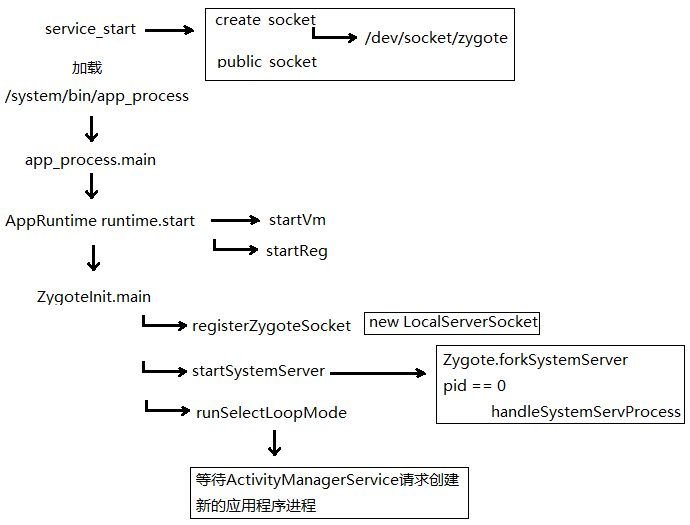
這張圖簡單說明了Zygote的啟動過程
下面重點解析這些函數,從app_process.main開始
int main(int argc, char* const argv[])
{
    ...

    // These are global variables in ProcessState.cpp
    mArgC = argc;
    mArgV = argv;

    mArgLen = 0;
    for (int i=0; i<argc; marglen="" appruntime="" const="" argv0="argv[0];" process="" command="" line="" arguments="" ignore="" everything="" up="" to="" or="" first="" non="" arg="" goes="" the="" vm="" int="" i="" parse="" runtime="" arguments.="" stop="" at="" unrecognized="" option.="" bool="" zygote="false;" startsystemserver="false;" application="false;" parentdir="NULL;" nicename="NULL;" classname="NULL;" while="" if="" else="" --nice-name=", 12) == 0) {
            niceName = arg + 12;
        } else {
            className = arg;
            break;
        }
    }

    if (niceName && *niceName) {
        setArgv0(argv0, niceName);
        set_process_name(niceName);
    }

    runtime.mParentDir = parentDir;

    if (zygote) {
	//這個start函數來自AppRuntime的父類
	//AndroidRuntime
        runtime.start(" :="" remainder="" of="" args="" get="" passed="" startup="" class="" runtime.mclassname="className;" runtime.margc="argc" -="" runtime.margv="argv" error:="" no="" name="" --zygote="" app_process:="" return="" pre="">
重點在start函數
這個函數在之前不止一次遇到過
void AndroidRuntime::start(const char* className, const char* options)
{
    ...

    /* start the virtual machine */
    JNIEnv* env;
    if (startVm(&mJavaVM, &env) != 0) {
        return;
    }
    onVmCreated(env);

    /*
     * Register android functions.
     */
    if (startReg(env) < 0) {
        ALOGE("Unable to register all android natives\n");
        return;
    }

    ...

    /*
     * Start VM.  This thread becomes the main thread of the VM, and will
     * not return until the VM exits.
     */
    char* slashClassName = toSlashClassName(className);
    jclass startClass = env->FindClass(slashClassName);
    if (startClass == NULL) {
        ALOGE("JavaVM unable to locate class '%s'\n", slashClassName);
        /* keep going */
    } else {
        jmethodID startMeth = env->GetStaticMethodID(startClass, "main",
            "([Ljava/lang/String;)V");
        if (startMeth == NULL) {
            ALOGE("JavaVM unable to find main() in '%s'\n", className);
            /* keep going */
        } else {
            env->CallStaticVoidMethod(startClass, startMeth, strArray);

#if 0
            if (env->ExceptionCheck())
                threadExitUncaughtException(env);
#endif
        }
    }
    free(slashClassName);

    ALOGD("Shutting down VM\n");
    if (mJavaVM->DetachCurrentThread() != JNI_OK)
        ALOGW("Warning: unable to detach main thread\n");
    if (mJavaVM->DestroyJavaVM() != 0)
        ALOGW("Warning: VM did not shut down cleanly\n");
}
前面是創建第一個虛擬機實例並且注冊JNI函數,然後執行className.main函數
這個className是com.android.internal.os.ZygoteInit
    public static void main(String argv[]) {
        try {
            // Start profiling the zygote initialization.
            SamplingProfilerIntegration.start();

            registerZygoteSocket();
            EventLog.writeEvent(LOG_BOOT_PROGRESS_PRELOAD_START,
                SystemClock.uptimeMillis());
            preload();
            EventLog.writeEvent(LOG_BOOT_PROGRESS_PRELOAD_END,
                SystemClock.uptimeMillis());

            // Finish profiling the zygote initialization.
            SamplingProfilerIntegration.writeZygoteSnapshot();

            // Do an initial gc to clean up after startup
            gc();

            // Disable tracing so that forked processes do not inherit stale tracing tags from
            // Zygote.
            Trace.setTracingEnabled(false);

            // If requested, start system server directly from Zygote
            if (argv.length != 2) {
                throw new RuntimeException(argv[0] + USAGE_STRING);
            }

            if (argv[1].equals("start-system-server")) {
                startSystemServer();
            } else if (!argv[1].equals("")) {
                throw new RuntimeException(argv[0] + USAGE_STRING);
            }

            Log.i(TAG, "Accepting command socket connections");

            runSelectLoop();

            closeServerSocket();
        } catch (MethodAndArgsCaller caller) {
            caller.run();
        } catch (RuntimeException ex) {
            Log.e(TAG, "Zygote died with exception", ex);
            closeServerSocket();
            throw ex;
        }
    }
主要內容有三個,registerZygoteSocket函數創建一個Server端Socket,用來接受AMS的創建進程請求
startSystemServer用來啟動System進程
runSelectLoopMode等待AMS請求創建進程
    private static void registerZygoteSocket() {
        if (sServerSocket == null) {
            int fileDesc;
            try {
		//ANDROID_SOCKET_ENV = "ANDROID_SOCKET_zygote"
                String env = System.getenv(ANDROID_SOCKET_ENV);
		//轉化為文件描述符
                fileDesc = Integer.parseInt(env);
            } catch (RuntimeException ex) {
                throw new RuntimeException(
                        ANDROID_SOCKET_ENV + " unset or invalid", ex);
            }

            try {
                sServerSocket = new LocalServerSocket(
                        createFileDescriptor(fileDesc));
            } catch (IOException ex) {
                throw new RuntimeException(
                        "Error binding to local socket '" + fileDesc + "'", ex);
            }
        }
    }
sServerSocket是ZygoteInit的一個靜態成員,用於保存創建的server socket
成功之後繼續執行startSystemServer來啟動SystemServer
    private static boolean startSystemServer()
            throws MethodAndArgsCaller, RuntimeException {
        /* Hardcoded command line to start the system server */
        String args[] = {
            "--setuid=1000",
            "--setgid=1000",
            "--setgroups=1001,1002,1003,1004,1005,1006,1007,1008,1009,1010,1018,3001,3002,3003,3006,3007",
            "--capabilities=130104352,130104352",
            "--runtime-init",
            "--nice-name=system_server",
            "com.android.server.SystemServer",
        };
        ZygoteConnection.Arguments parsedArgs = null;

        int pid;

        try {
            parsedArgs = new ZygoteConnection.Arguments(args);
            ZygoteConnection.applyDebuggerSystemProperty(parsedArgs);
            ZygoteConnection.applyInvokeWithSystemProperty(parsedArgs);

            /* Request to fork the system server process */
            pid = Zygote.forkSystemServer(
                    parsedArgs.uid, parsedArgs.gid,
                    parsedArgs.gids,
                    parsedArgs.debugFlags,
                    null,
                    parsedArgs.permittedCapabilities,
                    parsedArgs.effectiveCapabilities);
        } catch (IllegalArgumentException ex) {
            throw new RuntimeException(ex);
        }

        /* For child process */
        if (pid == 0) {
            handleSystemServerProcess(parsedArgs);
        }

        return true;
    }
這個SystemServer通過forkSystemServer創建,在SystemServer進程中執行的是handleSystemServerProcess
    private static void handleSystemServerProcess(
            ZygoteConnection.Arguments parsedArgs)
            throws ZygoteInit.MethodAndArgsCaller {

        closeServerSocket();

        // set umask to 0077 so new files and directories will default to owner-only permissions.
        Libcore.os.umask(S_IRWXG | S_IRWXO);

        if (parsedArgs.niceName != null) {
            Process.setArgV0(parsedArgs.niceName);
        }

        if (parsedArgs.invokeWith != null) {
            WrapperInit.execApplication(parsedArgs.invokeWith,
                    parsedArgs.niceName, parsedArgs.targetSdkVersion,
                    null, parsedArgs.remainingArgs);
        } else {
            /*
             * Pass the remaining arguments to SystemServer.
             */
            RuntimeInit.zygoteInit(parsedArgs.targetSdkVersion, parsedArgs.remainingArgs);
        }

        /* should never reach here */
    }
這個進程fork自Zygote,而根據Linux的fork原理可知,Zygote的ServerSocket也會被這個進程所共有,所以第一行
需要調用closeServerSocket將這個socket關閉
之後就調用RuntimeInit.zygoteInit
    public static final void zygoteInit(int targetSdkVersion, String[] argv)
            throws ZygoteInit.MethodAndArgsCaller {
        if (DEBUG) Slog.d(TAG, "RuntimeInit: Starting application from zygote");

        redirectLogStreams();

        commonInit();//設置通用信息
        nativeZygoteInit();//啟動一個Binder線程池

        applicationInit(targetSdkVersion, argv);
    }
繼續看調用的applicationInit
    private static void applicationInit(int targetSdkVersion, String[] argv)
            throws ZygoteInit.MethodAndArgsCaller {
        // If the application calls System.exit(), terminate the process
        // immediately without running any shutdown hooks.  It is not possible to
        // shutdown an Android application gracefully.  Among other things, the
        // Android runtime shutdown hooks close the Binder driver, which can cause
        // leftover running threads to crash before the process actually exits.
        nativeSetExitWithoutCleanup(true);

        // We want to be fairly aggressive about heap utilization, to avoid
        // holding on to a lot of memory that isn't needed.
        VMRuntime.getRuntime().setTargetHeapUtilization(0.75f);
        VMRuntime.getRuntime().setTargetSdkVersion(targetSdkVersion);

        final Arguments args;
        try {
            args = new Arguments(argv);
        } catch (IllegalArgumentException ex) {
            Slog.e(TAG, ex.getMessage());
            // let the process exit
            return;
        }

        // Remaining arguments are passed to the start class's static main
        invokeStaticMain(args.startClass, args.startArgs);
    }
最後通過invokeStatic來啟動入口函數,由前面可知,這裡的args.startClass是com.android.server.SystemServer
啟動的就是它的main函數
    public static void main(String[] args) {
        if (System.currentTimeMillis() < EARLIEST_SUPPORTED_TIME) {
            // If a device's clock is before 1970 (before 0), a lot of
            // APIs crash dealing with negative numbers, notably
            // java.io.File#setLastModified, so instead we fake it and
            // hope that time from cell towers or NTP fixes it
            // shortly.
            Slog.w(TAG, "System clock is before 1970; setting to 1970.");
            SystemClock.setCurrentTimeMillis(EARLIEST_SUPPORTED_TIME);
        }

        if (SamplingProfilerIntegration.isEnabled()) {
            SamplingProfilerIntegration.start();
            timer = new Timer();
            timer.schedule(new TimerTask() {
                @Override
                public void run() {
                    SamplingProfilerIntegration.writeSnapshot("system_server", null);
                }
            }, SNAPSHOT_INTERVAL, SNAPSHOT_INTERVAL);
        }

        // Mmmmmm... more memory!
        dalvik.system.VMRuntime.getRuntime().clearGrowthLimit();

        // The system server has to run all of the time, so it needs to be
        // as efficient as possible with its memory usage.
        VMRuntime.getRuntime().setTargetHeapUtilization(0.8f);

        Environment.setUserRequired(true);

        System.loadLibrary("android_servers");
        init1(args);
    }
這段代碼除了一個很萌的more memory注釋之外,就是調用native層的init1函數
static void android_server_SystemServer_init1(JNIEnv* env, jobject clazz)
{
    system_init();
}
我只想說這個函數很萌。。。
extern "C" status_t system_init()
{
    ALOGI("Entered system_init()");

    sp proc(ProcessState::self());

    sp sm = defaultServiceManager();
    ALOGI("ServiceManager: %p\n", sm.get());

    sp grim = new GrimReaper();
    sm->asBinder()->linkToDeath(grim, grim.get(), 0);

    char propBuf[PROPERTY_VALUE_MAX];
    property_get("system_init.startsurfaceflinger", propBuf, "1");
    if (strcmp(propBuf, "1") == 0) {
        // Start the SurfaceFlinger
        SurfaceFlinger::instantiate();
    }

    property_get("system_init.startsensorservice", propBuf, "1");
    if (strcmp(propBuf, "1") == 0) {
        // Start the sensor service
        SensorService::instantiate();
    }

    // And now start the Android runtime.  We have to do this bit
    // of nastiness because the Android runtime initialization requires
    // some of the core system services to already be started.
    // All other servers should just start the Android runtime at
    // the beginning of their processes's main(), before calling
    // the init function.
    ALOGI("System server: starting Android runtime.\n");
    AndroidRuntime* runtime = AndroidRuntime::getRuntime();

    ALOGI("System server: starting Android services.\n");
    JNIEnv* env = runtime->getJNIEnv();
    if (env == NULL) {
        return UNKNOWN_ERROR;
    }
    jclass clazz = env->FindClass("com/android/server/SystemServer");
    if (clazz == NULL) {
        return UNKNOWN_ERROR;
    }
    jmethodID methodId = env->GetStaticMethodID(clazz, "init2", "()V");
    if (methodId == NULL) {
        return UNKNOWN_ERROR;
    }
    env->CallStaticVoidMethod(clazz, methodId);

    ALOGI("System server: entering thread pool.\n");
    ProcessState::self()->startThreadPool();
    IPCThreadState::self()->joinThreadPool();
    ALOGI("System server: exiting thread pool.\n");

    return NO_ERROR;
}
GrimReaper用來接受Service Manager的死亡通知
啟動SurfaceFlinger、SensorServer,然後獲取前面的AndroidRuntime對象,之後通過這個對象調用com.android.server.SystemServer的init2函數
    public static final void init2() {
        Slog.i(TAG, "Entered the Android system server!");
        Thread thr = new ServerThread();
        thr.setName("android.server.ServerThread");
        thr.start();
    }
又回到了Java層,創建一個ServerThread類型的Thread,然後啟動
ServerThread.run這個函數很長
首先會創建一個消息循環
Looper.prepareMainLooper();然後啟動關鍵服務,並將它們在Service Manager中注冊
最後進入到消息循環當中
Looper.loop();這當中具體的關鍵服務下次再說,不然就扯遠了
回到之前我們所說的三個重要函數,還有最後一個runSelectLoopMode
在4.3中這個函數已經改名為runSelectLoop,不過沒啥關系
    private static void runSelectLoop() throws MethodAndArgsCaller {
        ArrayList fds = new ArrayList();
        ArrayList peers = new ArrayList();
        FileDescriptor[] fdArray = new FileDescriptor[4];

        fds.add(sServerSocket.getFileDescriptor());
        peers.add(null);

        int loopCount = GC_LOOP_COUNT;
        while (true) {
            int index;

            /*
             * Call gc() before we block in select().
             * It's work that has to be done anyway, and it's better
             * to avoid making every child do it.  It will also
             * madvise() any free memory as a side-effect.
             *
             * Don't call it every time, because walking the entire
             * heap is a lot of overhead to free a few hundred bytes.
             */
            if (loopCount <= 0) {
                gc();
                loopCount = GC_LOOP_COUNT;
            } else {
                loopCount--;
            }


            try {
                fdArray = fds.toArray(fdArray);
                index = selectReadable(fdArray);
            } catch (IOException ex) {
                throw new RuntimeException("Error in select()", ex);
            }

            if (index < 0) {
                throw new RuntimeException("Error in select()");
            } else if (index == 0) {
                ZygoteConnection newPeer = acceptCommandPeer();
                peers.add(newPeer);
                fds.add(newPeer.getFileDesciptor());
            } else {
                boolean done;
                done = peers.get(index).runOnce();

                if (done) {
                    peers.remove(index);
                    fds.remove(index);
                }
            }
        }
    }
創建一個4個socket大小的fdArray,表示Zygote最多同時處理4個socket連接,將前面創建出來的用於等待AMS發送請求的
sServerSocket加入到fds中。然後循環等待
首先將fds中的socket文件描述符轉移到fdArray中,調用selectReadable檢查fdArray中是否有可讀的數據
如果index為0,表示AMS與sServerSocket建立了連接
如果大於0,表示AMS發送了一個創建進程的請求,會調用ZygoteConnection的runOnce函數來創建一個新的應用進程
 Android進階——Preference詳解之Preference系的基本應用(三)
引言前面一篇文章介紹了二級Preference的使用和特點,接下來進入系統給我提供的底級Preference的使用CheckBox選擇項CheckBoxPreferenc
 Android Paint類介紹以及浮雕和陰影效果的設置
Paint類介紹Paint即畫筆,在繪制文本和圖形用它來設置圖形顏色, 樣式等繪制信息。1.圖形繪制setARGB(int a,int r,int g,int b);設置
 從AIDL看Android跨進程通信
AIDL是Android實現IPC的一種重要的方式,理解它的原理對理解Android進程間通信有很大的幫助。AIDL的定義,已經有很多介紹的文章了,這裡就不做詳解了。我們
 Android中如何搭建一個WebServer
今天終於把老大交代的任務搞完了,感覺收獲挺多的,所以就寫一篇來記錄一下吧,首先還是來看一下,老大們的需求 需求: 希望移動端的用戶標識(IMEI)和HTML頁面的用戶