

編輯:關於 Android 開發
為了解決方法數超過 65535 的問題,Google 建議用 MultiDex 來載入 classes2.dex、classes3.dex 等檔案。它的核心思路是在執行期動態修改 ClassLoader,從而達成動態載入類別的目的。
想真正理解 MultiDex 的原理,可以先了解 ClassLoader 的工作機制,再看 PathClassLoader 的原始碼——它繼承自 BaseDexClassLoader,主要邏輯都在 BaseDexClassLoader 中。整體流程如下:
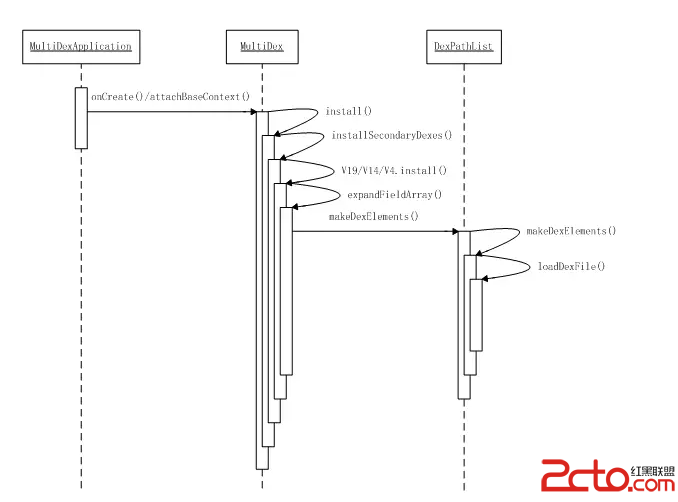
載入可以放在 Application 的 onCreate 或 Activity 的 attachBaseContext 中進行。
既然掌握了 MultiDex 的原始碼,我們就能改造它的 install 方法:從 assets 中解壓出需要載入的 apk,再呼叫 installSecondaryDexes 把它掛到當前 Application 的 ClassLoader 上。這樣一來,執行時就能用當前 ClassLoader 找到離線 apk 裡的類別了。
package net.mobctrl.hostapk;

import java.io.File;
import java.io.FilenameFilter;
import java.io.IOException;
import java.lang.reflect.Array;
import java.lang.reflect.Field;
import java.lang.reflect.InvocationTargetException;
import java.lang.reflect.Method;
import java.util.ArrayList;
import java.util.Arrays;
import java.util.HashSet;
import java.util.List;
import java.util.ListIterator;
import java.util.Set;
import java.util.zip.ZipFile;

import android.content.Context;
import android.content.pm.ApplicationInfo;
import android.content.pm.PackageManager;
import android.content.pm.PackageManager.NameNotFoundException;
import android.os.Build;
import android.util.Log;
import dalvik.system.DexFile;

public class AssetsMultiDexLoader {
    private static final String TAG = "AssetsApkLoader";
    private static boolean installed = false;
    private static final int MAX_SUPPORTED_SDK_VERSION = 20;
    private static final int MIN_SDK_VERSION = 4;
    private static final Set installedApk = new HashSet();

    private AssetsMultiDexLoader() { }

    /** 安裝 Assets 中的 apk 文件 */
    public static void install(Context context) {
        Log.i(TAG, "install...");
        if (installed) {
            return;
        }
        try {
            clearOldDexDir(context);
        } catch (Throwable t) {
            Log.w(TAG, "Something went wrong when trying to clear old MultiDex "
                    + "extraction, continuing without cleaning.", t);
        }
        AssetsManager.copyAllAssetsApk(context);
        Log.i(TAG, "install");

        if (Build.VERSION.SDK_INT < MIN_SDK_VERSION) {
            throw new RuntimeException("Multi dex installation failed. SDK "
                    + Build.VERSION.SDK_INT + " is unsupported. Min SDK version is "
                    + MIN_SDK_VERSION + ".");
        }

        try {
            ApplicationInfo applicationInfo = getApplicationInfo(context);
            if (applicationInfo == null) {
                // Looks like running on a test Context, so just return
                return;
            }

            synchronized (installedApk) {
                String apkPath = applicationInfo.sourceDir;
                if (installedApk.contains(apkPath)) {
                    return;
                }
                installedApk.add(apkPath);

                if (Build.VERSION.SDK_INT > MAX_SUPPORTED_SDK_VERSION) {
                    Log.w(TAG, "MultiDex is not guaranteed to work in SDK version "
                            + Build.VERSION.SDK_INT + ": SDK version higher than "
                            + MAX_SUPPORTED_SDK_VERSION + " should be backed by "
                            + "runtime with built-in multidex capabilty but it's not "
                            + "the case here: java.vm.version=\""
                            + System.getProperty("java.vm.version") + "\"");
                }

                /* The patched class loader is expected to be a descendant of
                 * dalvik.system.BaseDexClassLoader. We modify its
                 * dalvik.system.DexPathList pathList field to append additional
                 * DEX file entries. */
                ClassLoader loader;
                try {
                    loader = context.getClassLoader();
                } catch (RuntimeException e) {
                    Log.w(TAG, "Failure while trying to obtain Context class loader. "
                            + "Must be running in test mode. Skip patching.", e);
                    return;
                }
                if (loader == null) {
                    Log.e(TAG, "Context class loader is null. Must be running in test "
                            + "mode. Skip patching.");
                    return;
                }

                // 獲取 dex 文件列表
                File dexDir = context.getDir(AssetsManager.APK_DIR, Context.MODE_PRIVATE);
                File[] szFiles = dexDir.listFiles(new FilenameFilter() {
                    @Override
                    public boolean accept(File dir, String filename) {
                        return filename.endsWith(AssetsManager.FILE_FILTER);
                    }
                });

                List files = new ArrayList();
                for (File f : szFiles) {
                    Log.i(TAG, "load file:" + f.getName());
                    files.add(f);
                }

                Log.i(TAG, "loader before:" + context.getClassLoader());
                installSecondaryDexes(loader, dexDir, files);
                Log.i(TAG, "loader end:" + context.getClassLoader());
            }
        } catch (Exception e) {
            Log.e(TAG, "Multidex installation failure", e);
            throw new RuntimeException("Multi dex installation failed ("
                    + e.getMessage() + ").");
        }
        installed = true;
        Log.i(TAG, "install done");
    }

    private static ApplicationInfo getApplicationInfo(Context context)
            throws NameNotFoundException {
        PackageManager pm;
        String packageName;
        try {
            pm = context.getPackageManager();
            packageName = context.getPackageName();
        } catch (RuntimeException e) {
            Log.w(TAG, "Failure while trying to obtain ApplicationInfo from Context. "
                    + "Must be running in test mode. Skip patching.", e);
            return null;
        }
        if (pm == null || packageName == null) {
            return null;
        }
        return pm.getApplicationInfo(packageName, PackageManager.GET_META_DATA);
    }

    private static void installSecondaryDexes(ClassLoader loader, File dexDir,
            List files) throws IllegalArgumentException, IllegalAccessException,
            NoSuchFieldException, InvocationTargetException,
            NoSuchMethodException, IOException {
        if (!files.isEmpty()) {
            if (Build.VERSION.SDK_INT >= 19) {
                V19.install(loader, files, dexDir);
            } else if (Build.VERSION.SDK_INT >= 14) {
                V14.install(loader, files, dexDir);
            } else {
                V4.install(loader, files);
            }
        }
    }

    /** Locates a given field anywhere in the class inheritance hierarchy. */
    private static Field findField(Object instance, String name)
            throws NoSuchFieldException {
        for (Class clazz = instance.getClass(); clazz != null; clazz = clazz.getSuperclass()) {
            try {
                Field field = clazz.getDeclaredField(name);
                if (!field.isAccessible()) {
                    field.setAccessible(true);
                }
                return field;
            } catch (NoSuchFieldException e) {
                // ignore and search next
            }
        }
        throw new NoSuchFieldException("Field " + name + " not found in "
                + instance.getClass());
    }

    /** Locates a given method anywhere in the class inheritance hierarchy. */
    private static Method findMethod(Object instance, String name, Class... parameterTypes)
            throws NoSuchMethodException {
        for (Class clazz = instance.getClass(); clazz != null; clazz = clazz.getSuperclass()) {
            try {
                Method method = clazz.getDeclaredMethod(name, parameterTypes);
                if (!method.isAccessible()) {
                    method.setAccessible(true);
                }
                return method;
            } catch (NoSuchMethodException e) {
                // ignore and search next
            }
        }
        throw new NoSuchMethodException("Method " + name + " with parameters "
                + Arrays.asList(parameterTypes) + " not found in " + instance.getClass());
    }

    /**
     * Replace the value of a field containing a non null array, by a new array
     * containing the elements of the original array plus the elements of
     * extraElements.
     */
    private static void expandFieldArray(Object instance, String fieldName,
            Object[] extraElements) throws NoSuchFieldException, IllegalArgumentException,
            IllegalAccessException {
        Field jlrField = findField(instance, fieldName);
        Object[] original = (Object[]) jlrField.get(instance);
        Object[] combined = (Object[]) Array.newInstance(
                original.getClass().getComponentType(),
                original.length + extraElements.length);
        System.arraycopy(original, 0, combined, 0, original.length);
        System.arraycopy(extraElements, 0, combined, original.length, extraElements.length);
        jlrField.set(instance, combined);
    }

    private static void clearOldDexDir(Context context) throws Exception {
        File dexDir = context.getDir(AssetsManager.APK_DIR, Context.MODE_PRIVATE);
        if (dexDir.isDirectory()) {
            Log.i(TAG, "Clearing old secondary dex dir (" + dexDir.getPath() + ").");
            File[] files = dexDir.listFiles();
            if (files == null) {
                Log.w(TAG, "Failed to list secondary dex dir content ("
                        + dexDir.getPath() + ").");
                return;
            }
            for (File oldFile : files) {
                Log.i(TAG, "Trying to delete old file " + oldFile.getPath()
                        + " of size " + oldFile.length());
                if (!oldFile.delete()) {
                    Log.w(TAG, "Failed to delete old file " + oldFile.getPath());
                } else {
                    Log.i(TAG, "Deleted old file " + oldFile.getPath());
                }
            }
            if (!dexDir.delete()) {
                Log.w(TAG, "Failed to delete secondary dex dir " + dexDir.getPath());
            } else {
                Log.i(TAG, "Deleted old secondary dex dir " + dexDir.getPath());
            }
        }
    }

    /** Installer for platform versions 19. */
    private static final class V19 {
        private static void install(ClassLoader loader, List additionalClassPathEntries,
                File optimizedDirectory) throws IllegalArgumentException,
                IllegalAccessException, NoSuchFieldException,
                InvocationTargetException, NoSuchMethodException {
            Field pathListField = findField(loader, "pathList");
            Object dexPathList = pathListField.get(loader);
            ArrayList suppressedExceptions = new ArrayList();
            expandFieldArray(dexPathList, "dexElements",
                    makeDexElements(dexPathList,
                            new ArrayList(additionalClassPathEntries),
                            optimizedDirectory, suppressedExceptions));
            if (suppressedExceptions.size() > 0) {
                for (IOException e : suppressedExceptions) {
                    Log.w(TAG, "Exception in makeDexElement", e);
                }
                Field suppressedExceptionsField =
                        findField(loader, "dexElementsSuppressedExceptions");
                IOException[] dexElementsSuppressedExceptions =
                        (IOException[]) suppressedExceptionsField.get(loader);
                if (dexElementsSuppressedExceptions == null) {
                    dexElementsSuppressedExceptions = suppressedExceptions
                            .toArray(new IOException[suppressedExceptions.size()]);
                } else {
                    IOException[] combined = new IOException[suppressedExceptions.size()
                            + dexElementsSuppressedExceptions.length];
                    suppressedExceptions.toArray(combined);
                    System.arraycopy(dexElementsSuppressedExceptions, 0, combined,
                            suppressedExceptions.size(),
                            dexElementsSuppressedExceptions.length);
                    dexElementsSuppressedExceptions = combined;
                }
                suppressedExceptionsField.set(loader, dexElementsSuppressedExceptions);
            }
        }

        /** A wrapper around DexPathList#makeDexElements. */
        private static Object[] makeDexElements(Object dexPathList, ArrayList files,
                File optimizedDirectory, ArrayList suppressedExceptions)
                throws IllegalAccessException, InvocationTargetException,
                NoSuchMethodException {
            Method makeDexElements = findMethod(dexPathList, "makeDexElements",
                    ArrayList.class, File.class, ArrayList.class);
            return (Object[]) makeDexElements.invoke(dexPathList, files,
                    optimizedDirectory, suppressedExceptions);
        }
    }

    /** Installer for platform versions 14, 15, 16, 17 and 18. */
    private static final class V14 {
        private static void install(ClassLoader loader, List additionalClassPathEntries,
                File optimizedDirectory) throws IllegalArgumentException,
                IllegalAccessException, NoSuchFieldException,
                InvocationTargetException, NoSuchMethodException {
            Field pathListField = findField(loader, "pathList");
            Object dexPathList = pathListField.get(loader);
            expandFieldArray(dexPathList, "dexElements",
                    makeDexElements(dexPathList,
                            new ArrayList(additionalClassPathEntries),
                            optimizedDirectory));
        }

        /** A wrapper around DexPathList#makeDexElements. */
        private static Object[] makeDexElements(Object dexPathList, ArrayList files,
                File optimizedDirectory) throws IllegalAccessException,
                InvocationTargetException, NoSuchMethodException {
            Method makeDexElements = findMethod(dexPathList, "makeDexElements",
                    ArrayList.class, File.class);
            return (Object[]) makeDexElements.invoke(dexPathList, files, optimizedDirectory);
        }
    }

    /** Installer for platform versions 4 to 13. */
    private static final class V4 {
        private static void install(ClassLoader loader, List additionalClassPathEntries)
                throws IllegalArgumentException, IllegalAccessException,
                NoSuchFieldException, IOException {
            int extraSize = additionalClassPathEntries.size();

            Field pathField = findField(loader, "path");
            StringBuilder path = new StringBuilder((String) pathField.get(loader));
            String[] extraPaths = new String[extraSize];
            File[] extraFiles = new File[extraSize];
            ZipFile[] extraZips = new ZipFile[extraSize];
            DexFile[] extraDexs = new DexFile[extraSize];

            for (ListIterator iterator = additionalClassPathEntries.listIterator();
                    iterator.hasNext();) {
                File additionalEntry = iterator.next();
                String entryPath = additionalEntry.getAbsolutePath();
                path.append(':').append(entryPath);
                int index = iterator.previousIndex();
                extraPaths[index] = entryPath;
                extraFiles[index] = additionalEntry;
                extraZips[index] = new ZipFile(additionalEntry);
                extraDexs[index] = DexFile.loadDex(entryPath, entryPath + ".dex", 0);
            }

            pathField.set(loader, path.toString());
            expandFieldArray(loader, "mPaths", extraPaths);
            expandFieldArray(loader, "mFiles", extraFiles);
            expandFieldArray(loader, "mZips", extraZips);
            expandFieldArray(loader, "mDexs", extraDexs);
        }
    }
}
package net.mobctrl.hostapk;

import java.io.File;
import java.io.FileOutputStream;
import java.io.InputStream;
import java.io.OutputStream;

import android.content.Context;
import android.content.res.AssetManager;
import android.util.Log;

public class AssetsManager {
    public static final String TAG = "AssetsApkLoader";
    // 從 assets 複製出去的 apk 的目標目錄
    public static final String APK_DIR = "third_apk";
    // 文件結尾過濾
    public static final String FILE_FILTER = ".apk";

    /** 將資源文件中的 apk 文件拷貝到私有目錄中 */
    public static void copyAllAssetsApk(Context context) {
        AssetManager assetManager = context.getAssets();
        long startTime = System.currentTimeMillis();
        try {
            File dex = context.getDir(APK_DIR, Context.MODE_PRIVATE);
            dex.mkdir();
            String[] fileNames = assetManager.list("");
            for (String fileName : fileNames) {
                if (!fileName.endsWith(FILE_FILTER)) {
                    return;
                }
                InputStream in = null;
                OutputStream out = null;
                in = assetManager.open(fileName);
                File f = new File(dex, fileName);
                if (f.exists() && f.length() == in.available()) {
                    Log.i(TAG, fileName + " no change");
                    return;
                }
                Log.i(TAG, fileName + " chaneged");
                out = new FileOutputStream(f);
                byte[] buffer = new byte[2048];
                int read;
                while ((read = in.read(buffer)) != -1) {
                    out.write(buffer, 0, read);
                }
                in.close();
                in = null;
                out.flush();
                out.close();
                out = null;
                Log.i(TAG, fileName + " copy over");
            }
            Log.i(TAG, "###copyAssets time = " + (System.currentTimeMillis() - startTime));
        } catch (Exception e) {
            e.printStackTrace();
        }
    }
}
以上就是從 assets 載入 apk 的核心程式碼。
先開 BundleApk 專案編譯成 apk,把 BundleApk.apk 複製到 HostApk 專案的 assets 目錄,然後在 HostApk 的 MainActivity.onCreate 中呼叫 AssetsMultiDexLoader.install(getApplicationContext())。之後就能用兩種方式呼叫 BundleApk 中的類別。
方式一:Class.forName
由於 HostApk 沒有 BundleApk 類別的編譯期引用,必須用反射呼叫。
private void loadClass() {
    try {
        Class clazz = Class.forName("net.mobctrl.normal.apk.FileUtils");
        Constructor constructor = clazz.getConstructor();
        Object bundleUtils = constructor.newInstance();
        Method printSumMethod = clazz.getMethod("print", Context.class, String.class);
        printSumMethod.setAccessible(true);
        printSumMethod.invoke(bundleUtils, getApplicationContext(), "Hello");
    } catch (Exception e) {
        e.printStackTrace();
    }
}
方式二:ClassLoader.loadClass
也可以直接取得當前 ClassLoader,呼叫它的 loadClass。
@TargetApi(Build.VERSION_CODES.ICE_CREAM_SANDWICH)
private void loadApk() {
    try {
        Class clazz = getClassLoader().loadClass("net.mobctrl.normal.apk.Utils");
        Constructor constructor = clazz.getConstructor();
        Object bundleUtils = constructor.newInstance();
        Method printSumMethod = clazz.getMethod("printSum",
                Context.class, int.class, int.class, String.class);
        printSumMethod.setAccessible(true);
        Integer sum = (Integer) printSumMethod.invoke(
                bundleUtils, getApplicationContext(), 10, 20, "計算結果");
        System.out.println("debug:sum = " + sum);
    } catch (ClassNotFoundException e) {
        e.printStackTrace();
    } catch (SecurityException e) {
        e.printStackTrace();
    } catch (NoSuchMethodException e) {
        e.printStackTrace();
    } catch (IllegalArgumentException e) {
        e.printStackTrace();
    } catch (InstantiationException e) {
        e.printStackTrace();
    } catch (IllegalAccessException e) {
        e.printStackTrace();
    } catch (InvocationTargetException e) {
        e.printStackTrace();
    }
}
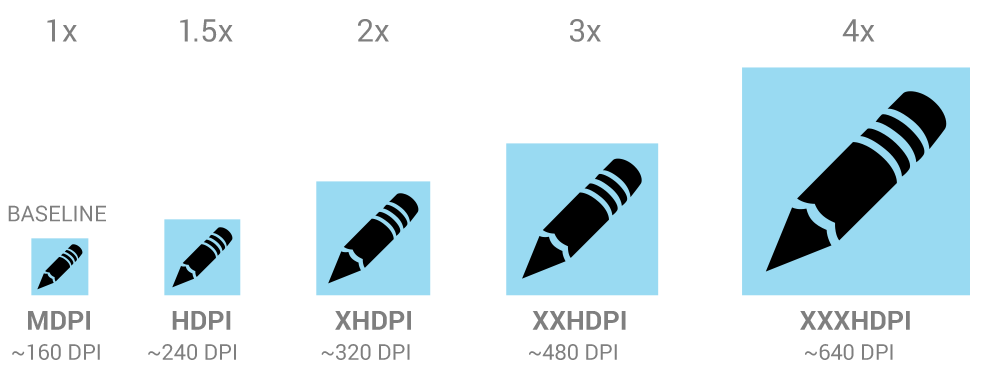 Android Bitmap 內存占用計算公式詳解
Bitmap 到底占用了多少內存? 在 Android 開發中,圖片內存優化一直是性能話題的重心,而 Bitmap 又是內存消耗的「大戶」。要優化,首先得學會計算它到底
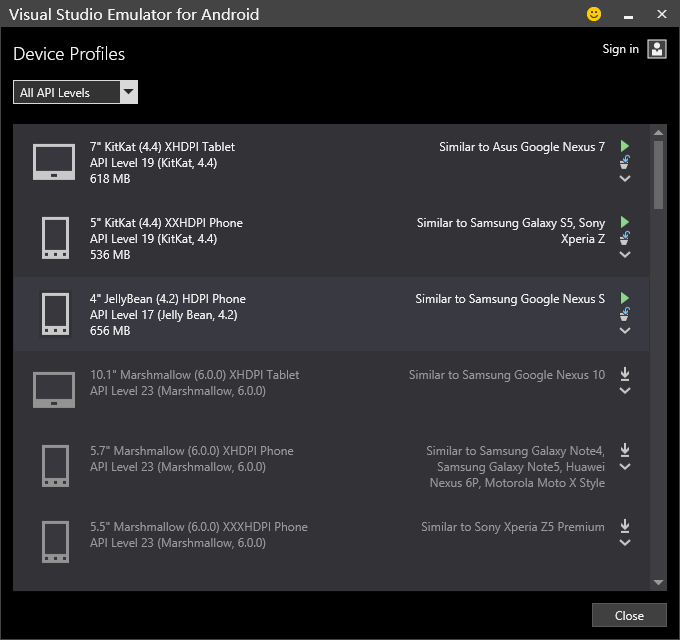 Visual Studio Emulator for Android 初體驗:流暢度媲美真機
Visual Studio Emulator for Android 已經推出一段時間了。近來實際安裝使用後,整體感覺比谷歌自帶的模擬器強不少。它沿襲了 Windows
 Android 自適應國際化語言設定
Android 自適應國際化語言,重點在於資源目錄的命名與 fallback 機制。只要在 res 下建立對應語言與地區的 values 目錄,系統就會依裝置語言自動載入
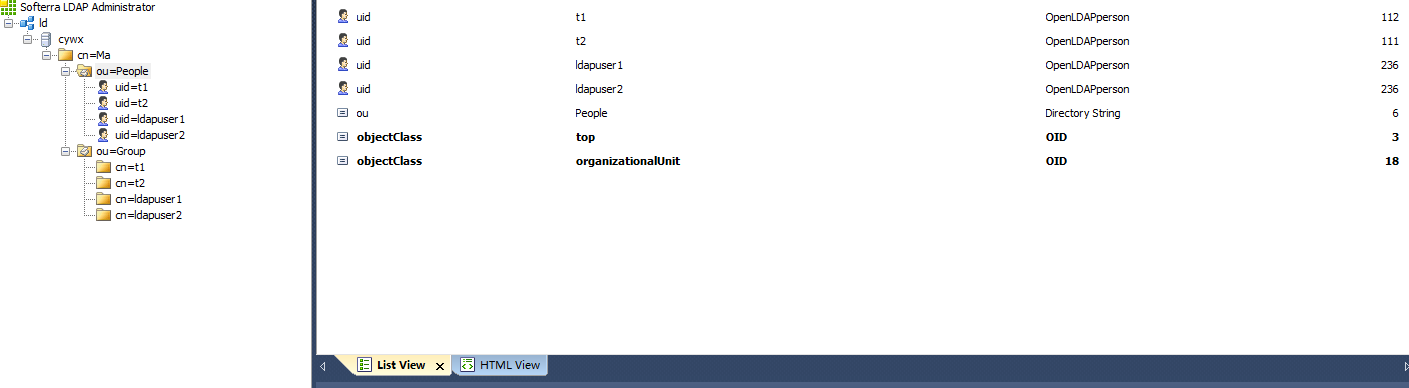 Redmine 整合 LDAP 認證:從 LDIF 資料準備到後台設定完整流程
 要把 Redmine 與 LDAP 帳號整合,第一步當然是先把 LDAP 環境設定好,否則