

編輯:Android 開發實例
Android 內建了四個處理 JSON 的類別,分別是 JSONArray、JSONObject、JSONStringer 以及 JSONTokenizer。
動手之前,先想清楚要抓哪些欄位。以下面這段 JSON 為例,我們感興趣的是其中的溫度:
{ "sys": { "country":"GB", "sunrise":1381107633, "sunset":1381149604 }, "weather":[ { "id":711, "main":"Smoke", "description":"smoke", "icon":"50n" } ], "main": { "temp":304.15, "pressure":1009, } }
一份 JSON 檔由多種元件組成,下表整理了各元件的意義:
要解析 JSON 物件,先建立一個 JSONObject 實體,並把含有 JSON 資料的字串傳入。語法如下:
String in; JSONObject reader = new JSONObject(in);
接著才進入真正的解析。由於 JSON 檔由不同物件、不同鍵值對組成,JSONObject 針對各種組成提供了對應的函式,語法如下:
JSONObject sys = reader.getJSONObject("sys"); country = sys.getString("country"); JSONObject main = reader.getJSONObject("main"); temperature = main.getString("temp");
其中 getJSONObject 會回傳該鍵對應的 JSON 物件,getString 則回傳指定鍵的字串值。
除此之外,這類還提供了更多便利的方法,能讓解析更靈活:
以下範例示範如何使用 JSONObject 類別,實作一個能連線天氣 API、解析 JSON 並顯示結果的簡易氣象 App。
你可以把 App 跑在實體裝置或模擬器上來測試。
以下是修改後的主程式 src/com.yiibai.jsonparser/MainActivity.java:
package com.example.jsonparser; import android.os.Bundle; import android.app.Activity; import android.view.Menu; import android.view.View; import android.widget.EditText; public class MainActivity extends Activity { private String url1 = "https://api.openweathermap.org/data/2.5/weather?q="; private EditText location,country,temperature,humidity,pressure; private HandleJSON obj; @Override protected void onCreate(Bundle savedInstanceState) { super.onCreate(savedInstanceState); setContentView(R.layout.activity_main); location = (EditText)findViewById(R.id.editText1); country = (EditText)findViewById(R.id.editText2); temperature = (EditText)findViewById(R.id.editText3); humidity = (EditText)findViewById(R.id.editText4); pressure = (EditText)findViewById(R.id.editText5); } @Override public boolean onCreateOptionsMenu(Menu menu) { // Inflate the menu; this adds items //to the action bar if it is present. getMenuInflater().inflate(R.menu.main, menu); return true; } public void open(View view){ String url = location.getText().toString(); String finalUrl = url1 + url; country.setText(finalUrl); obj = new HandleJSON(finalUrl); obj.fetchJSON(); while(obj.parsingComplete); country.setText(obj.getCountry()); temperature.setText(obj.getTemperature()); humidity.setText(obj.getHumidity()); pressure.setText(obj.getPressure()); } }
以下是 src/com.yiibai.jsonparser/HandleXML.java 的內容:
package com.example.jsonparser; import java.io.IOException; import java.io.InputStream; import java.io.InputStreamReader; import java.io.StringWriter; import java.io.UnsupportedEncodingException; import java.net.HttpURLConnection; import java.net.URL; import java.util.ArrayList; import java.util.List; import java.util.Map; import org.json.JSONObject; import org.xmlpull.v1.XmlPullParser; import org.xmlpull.v1.XmlPullParserFactory; import android.annotation.SuppressLint; public class HandleJSON { private String country = "county"; private String temperature = "temperature"; private String humidity = "humidity"; private String pressure = "pressure"; private String urlString = null; public volatile boolean parsingComplete = true; public HandleJSON(String url){ this.urlString = url; } public String getCountry(){ return country; } public String getTemperature(){ return temperature; } public String getHumidity(){ return humidity; } public String getPressure(){ return pressure; } @SuppressLint("NewApi") public void readAndParseJSON(String in) { try { JSONObject reader = new JSONObject(in); JSONObject sys = reader.getJSONObject("sys"); country = sys.getString("country"); JSONObject main = reader.getJSONObject("main"); temperature = main.getString("temp"); pressure = main.getString("pressure"); humidity = main.getString("humidity"); parsingComplete = false; } catch (Exception e) { // TODO Auto-generated catch block e.printStackTrace(); } } public void fetchJSON(){ Thread thread = new Thread(new Runnable(){ @Override public void run() { try { URL url = new URL(urlString); HttpURLConnection conn = (HttpURLConnection) url.openConnection(); conn.setReadTimeout(10000 /* milliseconds */); conn.setConnectTimeout(15000 /* milliseconds */); conn.setRequestMethod("GET"); conn.setDoInput(true); // Starts the query conn.connect(); InputStream stream = conn.getInputStream(); String data = convertStreamToString(stream); readAndParseJSON(data); stream.close(); } catch (Exception e) { e.printStackTrace(); } } }); thread.start(); } static String convertStreamToString(java.io.InputStream is) { java.util.Scanner s = new java.util.Scanner(is).useDelimiter("A"); return s.hasNext() ? s.next() : ""; } }
以下是版面配置 res/layout/activity_main.xml 的內容:
<RelativeLayout xmlns:android="https://schemas.android.com/apk/res/android" xmlns:tools="https://schemas.android.com/tools" android:layout_width="match_parent" android:layout_height="match_parent" android:paddingBottom="@dimen/activity_vertical_margin" android:paddingLeft="@dimen/activity_horizontal_margin" android:paddingRight="@dimen/activity_horizontal_margin" android:paddingTop="@dimen/activity_vertical_margin" tools:context=".MainActivity" > <TextView android:id="@+id/textView1" android:layout_width="wrap_content" android:layout_height="wrap_content" android:layout_alignParentLeft="true" android:layout_alignParentTop="true" android:layout_marginTop="15dp" android:text="@string/location" android:textAppearance="?android:attr/textAppearanceMedium" /> <EditText android:id="@+id/editText1" android:layout_width="wrap_content" android:layout_height="wrap_content" android:layout_alignBottom="@+id/textView1" android:layout_alignParentRight="true" android:ems="10" /> <TextView android:id="@+id/textView2" android:layout_width="wrap_content" android:layout_height="wrap_content" android:layout_alignLeft="@+id/textView1" android:layout_below="@+id/textView1" android:layout_marginTop="68dp" android:text="@string/country" android:textAppearance="?android:attr/textAppearanceSmall" /> <TextView android:id="@+id/textView3" android:layout_width="wrap_content" android:layout_height="wrap_content" android:layout_below="@+id/textView2" android:layout_marginTop="19dp" android:text="@string/temperature" android:textAppearance="?android:attr/textAppearanceSmall" /> <TextView android:id="@+id/textView4" android:layout_width="wrap_content" android:layout_height="wrap_content" android:layout_alignLeft="@+id/textView3" android:layout_below="@+id/textView3" android:layout_marginTop="32dp" android:text="@string/humidity" android:textAppearance="?android:attr/textAppearanceSmall" /> <TextView android:id="@+id/textView5" android:layout_width="wrap_content" android:layout_height="wrap_content" android:layout_alignLeft="@+id/textView4" android:layout_below="@+id/textView4" android:layout_marginTop="21dp" android:text="@string/pressure" android:textAppearance="?android:attr/textAppearanceSmall" /> <EditText android:id="@+id/editText2" android:layout_width="wrap_content" android:layout_height="wrap_content" android:layout_above="@+id/textView3" android:layout_toRightOf="@+id/textView3" android:ems="10" > <requestFocus /> </EditText> <EditText android:id="@+id/editText3" android:layout_width="wrap_content" android:layout_height="wrap_content" android:layout_alignBaseline="@+id/textView3" android:layout_alignBottom="@+id/textView3" android:layout_alignLeft="@+id/editText2" android:ems="10" /> <EditText android:id="@+id/editText4" android:layout_width="wrap_content" android:layout_height="wrap_content" android:layout_above="@+id/textView5" android:layout_alignLeft="@+id/editText1" android:ems="10" /> <EditText android:id="@+id/editText5" android:layout_width="wrap_content" android:layout_height="wrap_content" android:layout_alignBaseline="@+id/textView5" android:layout_alignBottom="@+id/textView5" android:layout_alignRight="@+id/editText4" android:ems="10" /> <Button android:id="@+id/button1" android:layout_width="wrap_content" android:layout_height="wrap_content" android:layout_alignLeft="@+id/editText2" android:layout_below="@+id/editText1" android:onClick="open" android:text="@string/weather" /> </RelativeLayout>
以下是 res/values/string.xml 的內容:
<?xml version="1.0" encoding="utf-8"?> <resources> <string name="app_name">JSONParser</string> <string name="action_settings">Settings</string> <string name="hello_world">Hello world!</string> <string name="location">Location</string> <string name="country">Country:</string> <string name="temperature">Temperature:</string> <string name="humidity">Humidity:</string> <string name="pressure">Pressure:</string> <string name="weather">Weather</string> </resources>
以下是 AndroidManifest.xml 的內容:
<?xml version="1.0" encoding="utf-8"?> <manifest xmlns:android="https://schemas.android.com/apk/res/android" package="com.yiibai.jsonparser" android:versionCode="1" android:versionName="1.0" > <uses-sdk android:minSdkVersion="8" android:targetSdkVersion="17" /> <uses-permission android:name="android.permission.INTERNET"/> <application android:allowBackup="true" android:icon="@drawable/ic_launcher" android:label="@string/app_name" android:theme="@style/AppTheme" > <activity android:name="com.yiibai.jsonparser.MainActivity" android:label="@string/app_name" > <intent-filter> <action android:name="android.intent.action.MAIN" /> <category android:name="android.intent.category.LAUNCHER" /> </intent-filter> </activity> </application> </manifest>
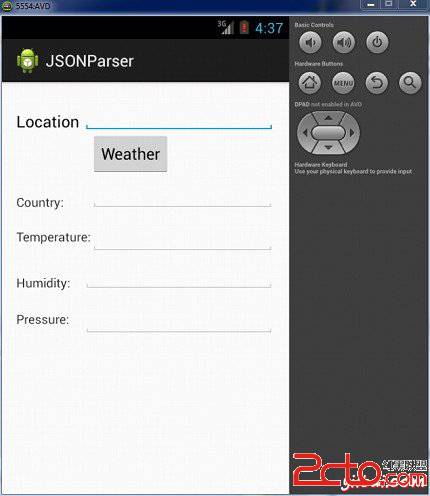
準備好後,把 JSONParser 安裝到 AVD 並啟動。若一切正常,模擬器會顯示如下畫面:
接著在位置欄位輸入任一城市,例如我示範輸入紐約,按下「weather」按鈕後,畫面會像下圖這樣:
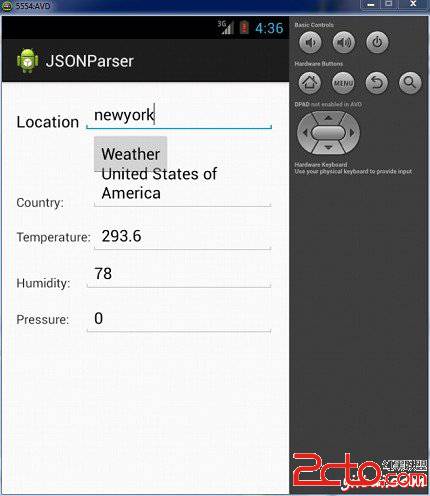
按下「weather」後,App 便會連線天氣 API,抓取下載對應的 JSON 檔並加以解析。以紐約為例,會回傳類似如下的資料:
提醒你,這個 API 回傳的溫度是以克氏溫標(Kelvin)表示的,若想轉換成比較直覺的攝氏溫度,記得自行換算。
 Android 學習筆記:單元測試實例完整解析
本文以實例方式,完整說明如何在 Android 專案中設定並執行單元測試。測試是開發流程中不可或缺的一環,透過 JUnit 框架能有效驗證程式的正確性。第一步:修改 An
 Android 開發最佳實踐:輸入體驗、背景作業、效能與資安
寫 Android 時有一些做法值得養成習慣。這些建議一部分來自官方文件,一部分是社群在長期實務中沉澱出來的共識,涵蓋互動設計、效能、安全性與隱私、相容性、測試、散布與變
 Android 應用本地化:讓 App 輕鬆支援多語言與地區
Android 應用往往運行在name不同國家、不同語言環境的裝置上。若希望 App 真正做到「在地化」,就必須讓文字、數字、日期與檔案等资源都能依裝置的語言環境自動切換
 Android 音樂播放器實作:MediaPlayer 播放、暫停與快轉教學
Android 提供多種播放音訊與影片的方式,其中最通用的是 MediaPlayer 類別。它站在系統內建的媒體播放服務之上,本機檔案與串流都能處理。 建立物件 最省事