編輯:關於Android編程
具體原理這裡就不說了 我也沒理順 網上有很多文章都說的很清楚 這裡我就直接上重點
主要修改文件
frameworks/base/service/java/com/android/server/usb/UsbService.java
frameworks/base/service/java/com/android/server/usb/UsbHostManager.java
首先將UsbService.java中的public UsbService(Context context)改為這樣
    public UsbService(Context context) {
        mContext = context;
        mSettingsManager = new UsbSettingsManager(context);
        PackageManager pm = mContext.getPackageManager();
        //if (pm.hasSystemFeature(PackageManager.FEATURE_USB_HOST)) {//modify by hclydao
            mHostManager = new UsbHostManager(context, mSettingsManager);
        //}
        if (new File("/sys/class/android_usb").exists()) {
            mDeviceManager = new UsbDeviceManager(context, mSettingsManager);
        }
    }
不然usbhostmanager不會執行
接下來主要就是修改usbhostmanager了 當硬件usb host插入裡會執行usbhostmanager裡的usbDeviceAdded函數 拔掉時會執行usbDeviceRemoved
當設備插入時在usb jni裡會回調usbDeviceAdded函數 此時會傳回這個usb設備的相關信息 但是發現class都是0 還好 在int [] interfaceValues傳回了整個usb相關信息interfaceValues[1] 對應的就是相應的class 3對應的是usb
hid 8對應的是mass storage 9對就的是usb hub 提示圖片和信息直接使用系統自帶的
最後修改為如下
/*
 * Copyright (C) 2011 The Android Open Source Project
 *
 * Licensed under the Apache License, Version 2.0 (the "License");
 * you may not use this file except in compliance with the License.
 * You may obtain a copy of the License at
 *
 *      http://www.apache.org/licenses/LICENSE-2.0
 *
 * Unless required by applicable law or agreed to in writing, software
 * distributed under the License is distributed on an "AS IS" BASIS,
 * WITHOUT WARRANTIES OR CONDITIONS OF ANY KIND, either express or implied.
 * See the License for the specific language governing permissions an
 * limitations under the License.
 */

package com.android.server.usb;

import android.app.PendingIntent;
import android.content.BroadcastReceiver;
import android.content.ContentResolver;
import android.content.Context;
import android.content.Intent;
import android.content.IntentFilter;
import android.hardware.usb.IUsbManager;
import android.hardware.usb.UsbConstants;
import android.hardware.usb.UsbDevice;
import android.hardware.usb.UsbEndpoint;
import android.hardware.usb.UsbInterface;
import android.hardware.usb.UsbManager;
import android.net.Uri;
import android.os.Binder;
import android.os.Bundle;
import android.os.Handler;
import android.os.Message;
import android.os.Parcelable;
import android.os.ParcelFileDescriptor;
import android.os.UEventObserver;
import android.provider.Settings;
import android.util.Slog;

import java.io.File;
import java.io.FileDescriptor;
import java.io.FileReader;
import java.io.PrintWriter;
import java.util.HashMap;
import java.util.List;
import android.app.Notification;
import android.app.NotificationManager;
import android.content.res.Resources;
import java.util.ArrayList;
/**
 * UsbHostManager manages USB state in host mode.
 */
public class UsbHostManager {
    private static final String TAG = UsbHostManager.class.getSimpleName();
    private static final boolean LOG = false;

    // contains all connected USB devices
    private final HashMap mDevices = new HashMap();

    // USB busses to exclude from USB host support
    private final String[] mHostBlacklist;

    private final Context mContext;
    private final Object mLock = new Object();
    private final UsbSettingsManager mSettingsManager;
	private Notification mUsbHostNotification;
	private ArrayList dlist;
    public UsbHostManager(Context context, UsbSettingsManager settingsManager) {
        mContext = context;
        mSettingsManager = settingsManager;
        mHostBlacklist = context.getResources().getStringArray(
                com.android.internal.R.array.config_usbHostBlacklist);
    }

    private boolean isBlackListed(String deviceName) {
        int count = mHostBlacklist.length;
        for (int i = 0; i < count; i++) {
            if (deviceName.startsWith(mHostBlacklist[i])) {
                return true;
            }
        }
        return false;
    }

    /* returns true if the USB device should not be accessible by applications */
    private boolean isBlackListed(int clazz, int subClass, int protocol) {
        // blacklist hubs
        if (clazz == UsbConstants.USB_CLASS_HUB) return true;

        // blacklist HID boot devices (mouse and keyboard)
        if (clazz == UsbConstants.USB_CLASS_HID &&
                subClass == UsbConstants.USB_INTERFACE_SUBCLASS_BOOT) {
            return true;
        }

        return false;
    }

    /* Called from JNI in monitorUsbHostBus() to report new USB devices */
    private void usbDeviceAdded(String deviceName, int vendorID, int productID,
            int deviceClass, int deviceSubclass, int deviceProtocol,
            /* array of quintuples containing id, class, subclass, protocol
               and number of endpoints for each interface */
            int[] interfaceValues,
           /* array of quadruples containing address, attributes, max packet size
              and interval for each endpoint */
            int[] endpointValues) {
		if((interfaceValues != null) && (interfaceValues[1] == UsbConstants.USB_CLASS_HID)) {//add by hclydao
            setUsbHostNotification(
                    com.android.internal.R.string.usb_storage_notification_title,
                    com.android.internal.R.string.usb_storage_notification_title,
                    com.android.internal.R.drawable.stat_sys_tether_usb, true, true, null);
			if(dlist == null)
				dlist = new ArrayList();
			dlist.add(deviceName);
		}
        if (isBlackListed(deviceName) ||
                isBlackListed(deviceClass, deviceSubclass, deviceProtocol)) {
            return;
        }

        synchronized (mLock) {
            if (mDevices.get(deviceName) != null) {
                Slog.w(TAG, "device already on mDevices list: " + deviceName);
                return;
            }

            int numInterfaces = interfaceValues.length / 5;
            Parcelable[] interfaces = new UsbInterface[numInterfaces];
            try {
                // repackage interfaceValues as an array of UsbInterface
                int intf, endp, ival = 0, eval = 0;
                for (intf = 0; intf < numInterfaces; intf++) {
                    int interfaceId = interfaceValues[ival++];
                    int interfaceClass = interfaceValues[ival++];
                    int interfaceSubclass = interfaceValues[ival++];
                    int interfaceProtocol = interfaceValues[ival++];
                    int numEndpoints = interfaceValues[ival++];

                    Parcelable[] endpoints = new UsbEndpoint[numEndpoints];
                    for (endp = 0; endp < numEndpoints; endp++) {
                        int address = endpointValues[eval++];
                        int attributes = endpointValues[eval++];
                        int maxPacketSize = endpointValues[eval++];
                        int interval = endpointValues[eval++];
                        endpoints[endp] = new UsbEndpoint(address, attributes,
                                maxPacketSize, interval);
                    }

                    // don't allow if any interfaces are blacklisted
                    if (isBlackListed(interfaceClass, interfaceSubclass, interfaceProtocol)) {
                        return;
                    }
                    interfaces[intf] = new UsbInterface(interfaceId, interfaceClass,
                            interfaceSubclass, interfaceProtocol, endpoints);
                }
            } catch (Exception e) {
                // beware of index out of bound exceptions, which might happen if
                // a device does not set bNumEndpoints correctly
                Slog.e(TAG, "error parsing USB descriptors", e);
                return;
            }

            UsbDevice device = new UsbDevice(deviceName, vendorID, productID,
                    deviceClass, deviceSubclass, deviceProtocol, interfaces);
            mDevices.put(deviceName, device);
            mSettingsManager.deviceAttached(device);
        }
    }

    /* Called from JNI in monitorUsbHostBus to report USB device removal */
    private void usbDeviceRemoved(String deviceName) {
		if(dlist != null) {
			for(int i = 0;i
 從零開始學android(Message消息機制.四十二.)
ndroid.os.Message的主要功能是進行消息的封裝,並且同時可以指定消息的操作形式。 No. 變量或方法 類型 描述 1 p
 android開發筆記之網絡編程—異步加載(AsyncTask)
看了前面的文章我們知道請求網絡的幾種方式:1.使用TCP協議和URL進行網絡編程 a)基於TCP協議:ServerSocket,Socket b)基於URL:
 Android 5.0 Usb調試攔截分析及修改
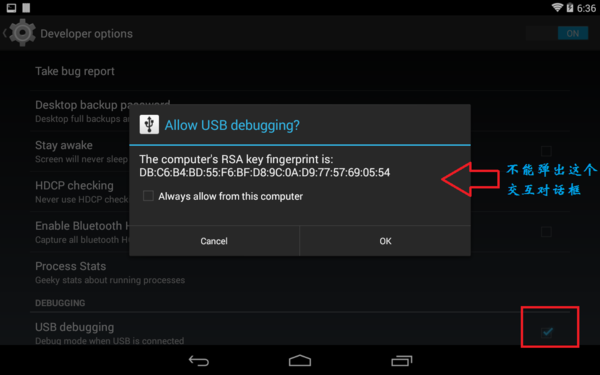
當我們調試安卓機器時,第一次插上usb線,會彈出一個授權的對話框,(前提是打開了usb調試功能)點擊確認,才會允許調試.如果我們想機器默認就可以調試該怎麼做呢?如果我們想
 android6.0源碼分析之Camera API2.0下的Capture流程分析
android6.0源碼分析之Camera API2.0下的Capture流程分析 前面對Camera2的初始化以及預覽的相關流程進行了詳細分析,本文將會對Ca